

Conclusion: To set up multi-variation products in a foreign-trade store, follow three steps: variable product + attributes + variations. Attributes define the parameter names and options, such as color and size. Variations handle pricing, images, and stock for each combination. If all colors share one price, create a single variation using 'Any color.' If colors need individual prices, create a separate variation for each color. You can get one SKU group running in about 5 minutes.
What products need variable products instead of simple products?
The test is simple: if customers choose color, size, material, or pack quantity under the same product URL, and different options may have different prices, use a variable product. Typical cases include apparel (red/blue + S/M/L), hardware fittings (model + length), and gifts (color + printing method).
Conversely, if all options share the same price, weight, and stock policy, a simple product plus a spec table is lighter. Too many meaningless variations on a product page make customers hesitate at the option fields, and both inquiries and orders will drop.
The product page is the first place conversion happens. Explain 'who you are + what you solve' within the first 3 seconds, then follow with the spec table and MOQ. This rule matters more than how you build variations in the backend.
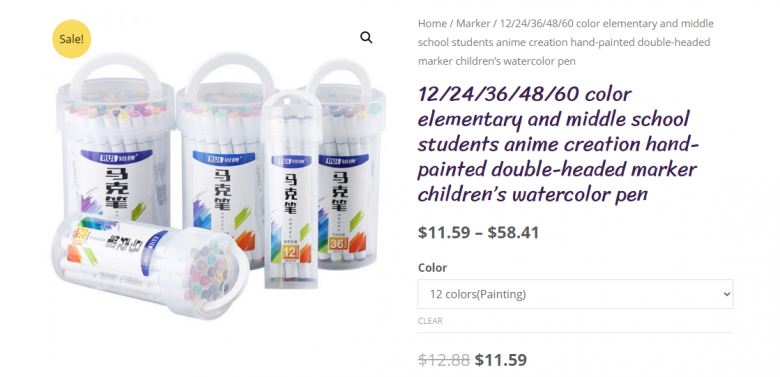
Step 1: How do you fill in attributes so colors and sizes stay clean?
When adding a product, switch the product type to Variable product in the product data. You will use two modules in the backend: 'Attributes' and 'Variations.' They have a fixed order: attributes come first, then variations can be generated.
After clicking 'Add,' enter the attribute name first. This name appears in the storefront options, so use your industry convention, such as color, size, or material. Check both boxes below. They control whether the attribute is visible on the storefront and whether it is used to create variations.
Separate attribute values with vertical bars, for example red|blue|orange or S|M|L. Two notes:
- Do not leave spaces in values, or extra options will appear on the storefront.
- Once a value has been used in an order, do not rename it casually. A new value equals a new option.
- You must click Save attributes after filling in values. If you do not save, you cannot select these values in variations.
To keep colors visually consistent, you can use the HTML color code chart to assign a consistent color value to each swatch. Color swatches are more intuitive than text.
Step 2: How do you create variations, and how do you handle same-price vs. individual pricing?
Click 'OK' to add variation values, and the backend will combine the attributes you checked into options. Handle three cases separately:
- All colors at the same price: Create one variation directly with 'Any color.' Move it below the variations; an arrow appears. Click it and fill in price, weight, stock, and shipping. Change the price once and it applies to all colors.
- One color at an individual price: Select that color to generate a variation, click the arrow to expand it, and set the image, price, and stock for that color separately.
- Color × size combinations: Check both attributes to generate variations. You will get combinations such as red-S, red-M, and blue-M, and each combination can have its own price and stock.
Click Save changes when done. A common mistake is saving only the attributes and not the changes. The options then show on the storefront but cannot be selected or added to the cart.
| Business scenario | Attribute setup | Variation setup | Suitable products |
|---|---|---|---|
| Multiple colors, same price | color: red|blue|orange | Any color, one variation | Freebies, accessories, low-priced items at one price |
| One color at an individual price | color: red|blue | Create a variation for each color | Custom products with different processes |
| Color + size | color + size, two attributes | Combination variations, priced by group | Apparel, bags, footwear |
| Quantity tier pricing | Quantity as an attribute value | One variation each for 10pcs/100pcs/1000pcs | Wholesale, sample orders |
How do you build wholesale tier pricing with variations?
Create an attribute called quantity and write values as 10pcs|100pcs|1000pcs. Then use variations to set a separate price for each quantity tier. When a customer selects 100pcs on the storefront, the price jumps to the matching tier, and your sales team does not need to quote back and forth.
The value of this approach is customer filtering. Small-order customers see tier pricing and may increase their quantity themselves. Large-order customers see your price structure and are more likely to send an inquiry. B2B websites are especially suited to this kind of product page presentation. For the structure, see B2B foreign-trade website solutions.
Do not make quantity tiers too dense. Three tiers are enough. The denser they are, the harder it is for customers to decide which tier to choose.
What technical details still matter for multi-variation product pages in 2026?
Configuring variations is only the content layer. In 2026, Google's AI Overviews and AI Mode will directly pull conclusion sentences from indexable pages. Whether a page can be crawled and indexed is the prerequisite for being cited. Google officially states that AI Overviews do not require extra structured data, so good SEO is good GEO.
Speed is the real bottleneck. Core Web Vitals pass thresholds are LCP ≤ 2.5s, INP ≤ 200ms, and CLS ≤ 0.1. Multi-variation product pages have many images and many SKU images, so two pitfalls are most common:
- The first-screen hero image uses a CSS background-image. The browser must parse CSS before it discovers the image, which slows LCP. Change it to
- Images do not have fixed width/height. Layout shifts when colors are switched, and CLS goes over the limit.
If variation image switching lags, it is usually a script conflict. For troubleshooting, see How to fix 'jQuery is not defined'. About 53% of users leave immediately if mobile loading takes more than 3 seconds, so product page images must be compressed.
Multi-variation products also attract spam inquiries and invalid comments. For handling, see How to handle spam inquiries and comments. If your site has no traffic yet, first read Why an independent site has no traffic or inquiries. Do not keep struggling with variation settings.
FAQ
What is the maximum number of variations for one product?
There is no hard technical limit, but there is a limit to storefront experience. Two attributes with 3 to 5 values each work well. More than 20 combinations overwhelms customers, and conversion drops.
What is the difference between attribute values and variations? Will changing one affect the other?
Attributes define 'what options exist.' Variations define 'how much this option sells for, how much stock it has, and what image it uses.' Changing an attribute value name creates a new option, and existing variation prices do not automatically carry over. Always test on a small scale first.
How do I show different product images for different colors?
Create a variation for each color, click the arrow after the variation to expand it, and upload the image for that color separately. Even when the price is the same, you still need separate variations to use different images. 'Any color' only lets you share one set of images.
Can tiered wholesale prices be calculated automatically in the cart?
Use variations to make each quantity tier a separate option. When a customer selects 100pcs, it is the 100pcs price, and the cart prices by option. This is more stable than installing an extra plugin and easier for search engines to read price content.