

The point of a multilingual export site isn't to look international. It's three concrete jobs: let customers in Japan, Germany and Brazil read your product pages in their own language; get those language versions indexed by local Google; and have a matching landing page when you run Google Ads in that country. In 2026 AI Overviews show up above most informational queries, and the precondition for being cited is still that a page can be crawled, indexed and ranked. A multilingual site simply copies that precondition into more language markets.
What a Multilingual Site Actually Delivers: 4 Visible Changes
First, coverage of small-language search. Google has separate country entry points, such as google.co.jp in Japan and google.com.tr in Turkey. Only a site with Japanese or Turkish content has a chance of appearing on those results pages.
Second, ads land better. Target Japan with a pure English landing page and a high bounce rate is normal. Run ads to German-speaking markets and send them to a German page; Spanish-speaking markets get Spanish. That's basic ad matching.
Third, inquiries convert faster. Customers only fill in a form once they can read the spec table, MOQ and lead time. Say 'who you are + what you solve' within the first three seconds, and say it in their language — it beats English every time.
Fourth, you look stronger next to competitors. A competitor has English only; you have five languages. The first impression is broader reach and more professionalism. Winning a new customer costs about 5x more than keeping an existing one (industry rule of thumb), and multilingual pages also lower the communication barrier on repeat orders.
Which Languages First? Rank by Market and Inquiry Value
Don't launch ten languages at once. If the content can't be kept up, every page gets thin and drags the whole site down. Get English solid first, then add languages based on where inquiries come from.
- English: the site's main language, globally understood, and the source version for every other language.
- Pick 1–2 by inquiry share: German, French and Spanish are common in Europe; Japanese and Korean in Asia; Arabic in the Middle East (mind right-to-left layout).
- Follow your ad plans: whichever country you're about to push in Ads, build that language's landing page first.
- Check competition density: use tools to see how crowded your target keywords are in the local language. Start with the language where the fewest pages compete.
Reviewing the language versions your competitors run is a cheap way to decide. See using competitor website analysis to improve your own site.
Translation: Machine or Human?
One criterion decides it: word count. Sites with few product pages and lots of content get more value from human translation. Sites with hundreds or thousands of SKUs can't translate everything by hand, so the usual approach is human translation for core pages (home, about, flagship products, contact), machine translation for the rest, then a language speaker reviews the keywords.
| Page type | Recommended approach | Why |
|---|---|---|
| Home, About | Human translation | Sets trust; wording drives inquiries |
| Flagship product pages (top 10–20) | Human + local keyword review | Carries search traffic and ad landing |
| Long-tail product pages | Machine translation + spot checks | Too much volume; human cost doesn't pay |
| Blog / industry articles | Mostly machine translation | High update frequency; coverage comes first |
Machine translation is usually billed per character by third-party platforms. When writing product descriptions, have the tool output directly in the target language — easier than translating from Chinese. Tips here: tips and caveats for writing articles and product descriptions with ChatGPT.
Technical Details: Get These Wrong and the Work Is Wasted
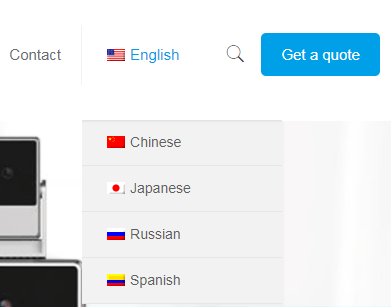
Put the language switcher on the right side of the menu bar as a dropdown so customers find it instantly. Each language version needs its own URL (subdirectory or subdomain). Don't serve everything from one URL with JavaScript, or search engines won't reach the other languages.
Add hreflang tags to every language page so Google knows which language and region it serves. Without them, versions compete with each other for rankings. Set fixed width/height on images to keep CLS in check; CLS ≤ 0.1, LCP ≤ 2.5s and INP ≤ 200ms are the 2026 'good' thresholds. Multilingual sites multiply page count, and a heavy template pushes INP over the line fast.
Once a language version goes live, wire up its inquiry form. A customer who submits a form and gets no notification is the most common invisible loss. On spam inquiries, see the ultimate fix for spam inquiries and comments in WordPress. If the language version needs a new server or a migration, see how to migrate a WordPress site to another host (e.g. Hostinger).
Multilingual Sites and AI Search: The 2026 Reality
Google has been explicit: getting into AI Overviews and AI Mode needs no extra structured data, special files or Markdown. Good SEO is good GEO. AI simply summarises pages that already rank. So the logic for multilingual sites hasn't changed — you need a ranking in the local-language results before a local-language AI summary can cite you.
But adjust your traffic expectations. Pew Research measured click-through to traditional results at about 8% when an AI summary appears, versus about 15% without one. Ahrefs data also shows the top result loses roughly 34.5% of clicks on queries with an AI Overview. Multilingual sites can't live on organic traffic alone — pair them with email, trade shows and repeat orders.
Another number worth noting: an Ahrefs study from March 2026 found that only 37.9% of URLs cited in AI Overviews also ranked in the top 10 for that query, while 31% ranked outside the top 100. That's an opening: specific, useful pages on your multilingual site that don't rank highly can still be picked up and summarised.
Don't skip the basics: make sure language pages aren't blocked by nosnippet or data-nosnippet and can be crawled and indexed normally. If inquiries stay flat across the whole site, check your traffic mix first: why your independent export site has no traffic or inquiries.
What to Do in the First 30 Days
- Submit each language version's sitemap separately in Search Console and watch indexing speed.
- Check for hreflang errors and confirm language/region pairs are correct.
- Re-check titles and descriptions against local keywords. Don't just translate the English title.
- Add the new landing pages to the matching Ads ad groups and watch the bounce rate.
- Core Web Vitals changes take about 4 weeks to show in Search Console (28-day rolling window), so don't jump to conclusions.
Common Questions
Will a multilingual site hurt my English rankings?
No, provided hreflang is correct and each language has its own URL. Problems come from sharing one URL across languages or misconfigured hreflang, which makes the versions compete.
We're a two- or three-person company. Can we maintain a multilingual site?
Yes, but cap it at 2–3 languages. Human translation for core pages, machine translation for the rest, spot-checks every quarter. Too many languages with content that never updates is worse than not doing it.
Will Google treat machine-translated content as low quality?
What matters isn't whether it's machine translated but whether the page has unique value. Pages with full specs, MOQ, lead times, real photos and cases can rank even when machine translated. Pages with a few product names won't rank even with human translation.
Do I need a separate design for the multilingual site?
No. Same template, different language content — though right-to-left languages like Arabic need their own layout adaptation. Keep the template light; the heavier the page builder, the easier it is to blow past 200ms INP.