

Turning a 10-minute product video into a 2,000-word blog gives the same content a second entry point — one Google can index and AI Overviews can cite. In 2026 search results, video itself earns no text ranking. A transcript does. Three moves: get the video file, machine-transcribe it and edit by hand, then restructure it under subheads and publish.
Why bother turning video into text in 2026?
At Google I/O in May 2026, Google reported AI Mode at roughly 1 billion monthly users, with AI Overviews answering directly above many informational queries. Pew Research measured the click-through effect: about 8% of users click a traditional result when an AI summary appears, versus about 15% when none does.
The doorway is narrower, but it is still a doorway — AI summaries pull from pages that already rank. Google cannot read text out of a video file, so there is nothing to cite. A transcript is the only ticket video has into the index.
There is another opening. Ahrefs research from March 2026 found that only 37.9% of URLs cited in AI Overviews also appeared in the top 10 organic results for that query (about 76% in July 2025), and another 31% ranked outside the top 100. AI goes looking for long-tail pages that answer clearly — and the parts of your video where a salesperson explains lead times, packaging, or certifications become exactly that kind of page once transcribed.
Do not forget the human reader. Some buyers simply will not watch video. They need to send a link to their boss in a meeting room, or scan for MOQ. The text version is for them. To get the site structure right first, see the B2B export website guidelines.
How many content formats can one video produce?
Do not stop at one blog post. The same text, cut differently, goes to different places and does different jobs.
| Format | Which part of the video | Where it goes | Reuse notes |
|---|---|---|---|
| Blog article | The full transcript | Site content section | Add subheads, a spec table, internal links |
| Product page FAQ | The 30-second answer after a customer question | Bottom of the product detail page | One question, one answer — keep the spoken wording |
| LinkedIn post | One fully argued point | Personal and company accounts | Lead with the conclusion |
| Cold email body | The problem description passage | Cut the pleasantries, keep it under 120 words | |
| Short video captions | The original audio track | TikTok, YouTube | Reuse the subtitle file as-is |
The second row is the most valuable in an export business. The questions customers ask most are MOQ, lead time, certifications, and packaging — and your salesperson has already answered all of them on video. Transcribe it and you have a ready-made FAQ with no writer needed.
Apart from the blog, every row in that table is a cut-and-paste job. No rewriting required. That is why transcription beats writing from scratch — writing means planning, transcribing means moving text and proofreading it.
How do you pick a transcription tool — is 90% accuracy good enough?
The original article used Transcribe Wreally, which claims about 90% accuracy on clear audio. That is not high by 2026 standards, but it is enough — the remaining 10% needs a human pass anyway, because spoken and written structure are completely different.
Judge a tool on three things only: can it take a video file rather than a link, can it export plain text, and can it handle your salesperson's accent. Indian accents, Middle Eastern accents, and Mandarin with a regional twang are where transcription errors cluster.
Do not skip the prep step: download the video file locally first. YouTube videos and livestream replays all need downloading — many tools cannot read a pasted link. Name files consistently as "product-topic-date" so you can still find them three months later.
How much editing does a transcript need before publishing?
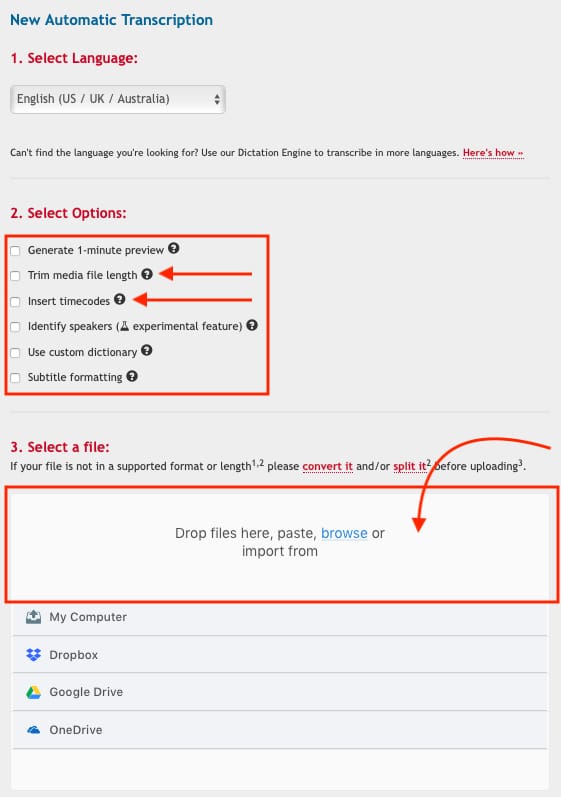
What comes out of the machine is one long run of text: no paragraphs, plenty of filler words, plenty of repetition. Publishing it as-is hands Google a low-quality page. Edit in this order:
- Read it through once and delete every filler word — "um", "like", "you know". Split any sentence longer than 40 words.
- Cut it into 3–6 h2 sections by content logic, with 2–4 paragraphs under each. Write subheads as questions customers actually search, such as "What is the MOQ?"
- Standardize product model numbers, materials, and certification names to your company's official spelling. No "CE" in one place and "ce" in another.
- Drop a spec table wherever you discuss specifications, and a step list wherever you walk through a process. Numbers read aloud on video must be scannable on a web page.
- Add 3–5 internal links back to product pages, case studies, or related articles. If you get stuck, use ChatGPT writing prompts for a first draft, then rewrite it in your sales team's language.
- Close with a form that has only three fields: name, email, requirement. Fewer fields, higher submit rate.
The whole job takes about two to three hours for a 2,000-word piece. Faster than writing from zero, slower than publishing untouched — but the gap shows up in rankings.
After publishing, how do you get AI search to cite the page?
Google has stated plainly that AI Overviews and AI Mode require no extra structured data, special files, or Markdown. Doing SEO well is doing GEO well. Only two things matter: the page must be crawlable and indexable, and it must not be blocked by nosnippet, max-snippet, or data-nosnippet.
Hit the 2026 Core Web Vitals thresholds: LCP ≤ 2.5s, INP ≤ 200ms, CLS ≤ 0.1. About 53% of users leave a mobile page that takes more than 3 seconds to load (Google data). Three cheapest wins: serve the hero image as an img tag with fetchpriority="high" instead of a CSS background; hard-code width and height on every image to crush CLS; defer third-party scripts like GA4, Meta Pixel, and live chat until after the user's first interaction — they are what destroys INP.
Do not check results the same day. Core Web Vitals uses a 28-day rolling window of real user data, so changes take about 4 weeks to surface in Search Console. Use that wait to distribute the blog across social channels — while avoiding common social media marketing mistakes, like posting the same link five times in one day.
For a systematic view of Google's traffic entry points, rank them against Google's five main promotion programs. If your site is not built yet, check the plan and pricing comparison first, then decide which site type should carry this content.
FAQ
How long a blog can a 10-minute video produce?
Roughly 1,500–2,000 words. Ten minutes at normal speaking pace is about 1,400–1,600 words; strip the filler, the self-introductions, and the repeated passages, then add spec tables and step lists, and you have a long-form article that can rank.
At 90% accuracy, does the whole transcript need manual proofreading?
It needs a full read, but not word-by-word checking. Focus on three places: product model numbers and figures, certification names, and the few answers customers ask about most. Get one of those wrong and every inquiry will ask the same question three times.
Does spoken language on a company website look unprofessional?
Spoken language is an asset; structure is what makes it professional. Keep how your salesperson explains the problem, shorten the sentences, and push the information into subheads and tables — it reads smoothly. Rewriting spoken language into stiff formal prose, on the other hand, throws away the most convincing details in the video.
Is publishing the same content on my site and YouTube duplicate content?
No. Video and text are different mediums, and Google indexes them separately. The real risk is republishing the same article verbatim across multiple domains you own — that is what makes them compete against each other.