

Who Nextdoor Ads Are For: Check These Three Numbers First
Nextdoor ads only suit businesses with a limited service radius that win deals on local word of mouth. The platform gives you just 2 free business posts a month, paid ads are priced by reach and flight length, and there are only two placements: the neighborhood newsfeed and the daily/weekly digest emails. If your customers sit in one town or city district, it is a low-cost way to reach neighbors. If you sell B2B across states or borders, it belongs behind Google organic search and your own website.
Local traffic entry points are multiplying in 2026. On November 4, 2026, Google launched a local service booking entry in AI Mode in the US, with partners including Angi, Thumbtack, Housecall Pro and Jobber. In other words, being found as a local service no longer happens only on community platforms, but also in conversational summaries on the search results page. Nextdoor is a trust amplifier, not your only acquisition channel.
The test is simple: does closing a deal depend on the same neighborhood, meeting in person, and a neighbor's recommendation? If all three are true, Nextdoor is worth doing. If only one is, treat it as a supporting channel first.
How Nextdoor Actually Differs from Other Social Platforms
The difference is the radius. Twitter, Facebook and Instagram default to spreading content outward. You can add geo-targeting, but the platforms were not built around neighborhoods. Nextdoor was divided by neighborhood from day one: users see posts from people in their own area, discussing local plumbers, roofs and pet sitters. So when someone asks "anyone know a reliable pest control company?", the people answering are often from the next street over.
That also explains why Nextdoor leans so hard on word of mouth. Commercial content is never welcome in a community, so the platform caps free business posts at 2 a month to keep the noise down. The rest of your exposure has to come from paid ads and recommendations between users. Your asset on Nextdoor is not follower count. It is how many times neighbors mention you.
For Chinese exporters, the logic needs a different application. If you have a US warehouse, local installation or a local after-sales team, Nextdoor can serve those local touchpoints. If all your customers are overseas and deals close over email and samples, this community play needs a local partner to execute. For channel decisions on your own site, see the five major promotion programs on Google platforms and put budget where it produces inquiries directly.
Setting Up a Business Page on Nextdoor in 2026: Full Steps
Building the page is not complicated. Getting the categories and details right is, because whether your later ads reach the right people depends on it.
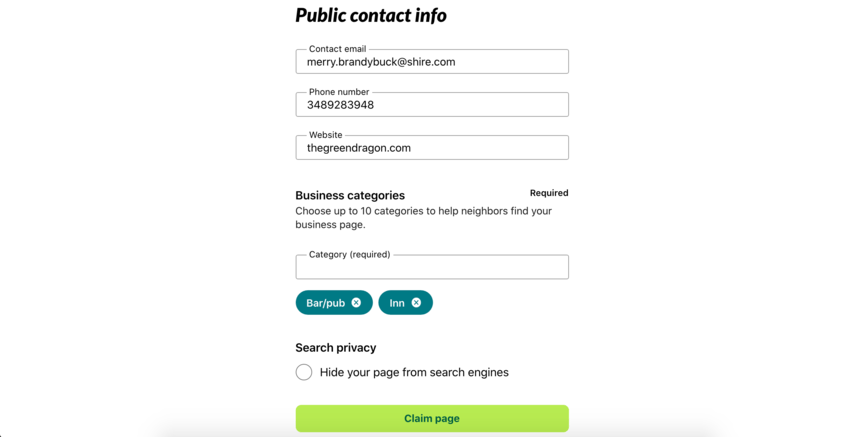
- Go to nextdoor.com/create-business and register with a business email. Do not mix it with a personal account.
- Enter your company name, physical address and phone number. The address defines which neighborhoods you can reach, so a wrong one means wasted spend.
- Choose up to 10 business categories, such as roofing or pest control. Overly broad categories drag relevance down.
- When the system asks about your role, always pick "Professional Business", not "Hire a neighbor".
- Click "Claim Page", then fill in your logo, cover image and description.
Once the page is live, hold off on spending. Use your free quota to publish all 2 business posts, watch how people in the area respond, and only then decide your ad budget and coverage. This "validate first, scale second" order is the same logic as paid search, except validation on Nextdoor costs less.
If you do not yet have a site that can convert the traffic, build the landing page before you advertise. Product pages need a spec table and MOQ, the first screen should answer "who you are + what you solve" within 3 seconds, and forms convert best with just three fields: name, email, requirement. For a site plan, start with B2B export websites; on a tight budget, use website building services to get the basic pages running first.
Ads Running but Nobody Responds? Three Actions That Work
First, treat replies as ad spend. Free posts are capped at 2 a month, but replying to other people's public questions is not. When someone asks "who knows a reliable supplier", answer as the business with concrete information instead of a hard pitch. That reply often earns more trust than a paid ad. Answer inbox messages the same day too.
Second, build recommendations deliberately. Nextdoor recommendations come from real neighbors, so praising yourself does little. The method: after finishing a job, explicitly ask the customer to say a word about you on the platform, and keep your local service quality consistent. That is the only way to generate recommendations at scale. With more recommendations, the same ad slot gets a noticeably higher click intent.
Third, watch one metric. The key metric in the Nextdoor dashboard is Organic Neighborhood Reach. It shows your organic reach in a specific area, revealing which neighborhoods recognize you and which are completely silent. Use it to adjust your ad coverage; it beats adding budget on gut feel.
- 2 free business posts a month: save them for your most important message, not daily updates
- Public Q&A: spend 10 minutes a day answering, as the business account
- Recommendations: ask right after the job is done; the goal is to turn your recommendation count into a visible asset
- Organic Neighborhood Reach: review it once a month and cut neighborhoods with zero response
- Ad landing page: past 3 seconds on mobile, about 53% of users leave (Google data), so test speed before you spend
Website Basics to Fix Before You Advertise (They Decide If Budget Is Wasted)
Social ad conversions land on your site in the end. In 2026 the passing bar for Core Web Vitals is LCP ≤ 2.5s, INP ≤ 200ms and CLS ≤ 0.1. INP officially replaced FID in March 2024. Use an img tag with fetchpriority="high" for the mobile hero image, not a CSS background-image, and hard-code width/height on every image. That is the cheapest way to cut CLS.
Third-party scripts are the biggest INP killer, including GA4, Meta Pixel, live chat and popups. The common fix is to delay loading until the user's first interaction (touchstart, mousemove, keydown, scroll). If you use a page builder, INP cost from worst to best runs Elementor, Divi, WPBakery, Beaver Builder, Bricks, GenerateBlocks, Kadence Blocks, native Gutenberg. In one real case, a 30-page site moved from Elementor to Bricks and went from 290ms to 110ms INP and 3.4s to 1.9s LCP, with about 16 hours of migration work. Note that Core Web Vitals uses a rolling 28-day field data window, so you need to wait 4 weeks to see changes in Search Console.
Do not skip the basics either. SSL is standard now, and Chrome flags sites without it as "Not secure", which hits inquiries directly. If you want to serve local ads and organic search at once, look at the structure of an AI-integrated marketing website, or check the plan and pricing comparison first to set your budget range.
| Item | Nextdoor Ads | Google Search / Own Website |
|---|---|---|
| Coverage | Specific neighborhoods and adjacent areas | Global or selected countries |
| Free exposure | 2 business posts per month | Unlimited, driven by content and rankings |
| Ad placements | Neighborhood newsfeed, daily/weekly digest emails | Search results, AI Overviews, AI Mode |
| Core trust source | Neighbor recommendations | Page content quality and external citations |
| Key metric | Organic Neighborhood Reach | Organic rankings, click-through rate, inquiry volume |
| Best-fit business | Local services, companies with a local team | B2B export, cross-border retail |
Local Advertising in 2026: How to Plan Alongside AI Search
Start with the facts: rankings have not changed. Only the shape of the results page has. AI simply summarizes pages that already rank. Google has stated clearly that appearing in AI Overviews or AI Mode requires no extra structured data, special files or Markdown — "good SEO is good GEO". So your local ad landing page should still be built to be crawlable, indexable and free of nosnippet restrictions.
Click behavior has changed, though. Pew Research testing shows users click traditional results about 8% of the time when an AI summary appears, versus about 15% without one. Ahrefs data also shows the top result's click-through rate dropping about 34.5% on queries with AI Overviews. Meanwhile, Ahrefs research from March 2026 found that only 37.9% of URLs cited in AI Overviews also appear in the top 10 organic results for that query (about 76% in July 2025), and another 31% rank outside the top 100.
For local businesses, the takeaway is: do not bet on a single entry point. Nextdoor handles trust and recommendations inside the neighborhood; your own site handles being found and cited by search and AI summaries. Run both. In practice, start with the "Search generative AI" toggle in Search Console to see the data (fully rolled out by August 31, 2026, included by default), then decide where to invest in content.
FAQ
How many free business posts can I publish on Nextdoor each month?
2 per month. This is a hard platform limit designed to keep community feeds from being flooded with commercial content. Paid ads are not subject to this cap and are priced by reach and flight length.
Are Nextdoor ads a good fit for Chinese export companies?
It depends on whether you have local touchpoints. If you have a US warehouse, installation or after-sales team, you can advertise to those specific neighborhoods. If all your customers are overseas and deals close over email and samples, prioritize Google organic search and website conversion, using the page structure in B2B export websites as a reference.
Which metric should I watch for Nextdoor ad performance?
Start with Organic Neighborhood Reach. It reflects your organic reach and engagement in a specific area, shows you the strong spots and the blank ones, and is the most direct way to adjust your ad coverage.
What technical metrics matter for the ad landing page?
LCP ≤ 2.5s, INP ≤ 200ms and CLS ≤ 0.1. Use an img with fetchpriority="high" for the hero image, hard-code width and height on all images, and delay third-party scripts until after the first interaction. After changes, wait for the 28-day rolling window before checking Search Console.