

No traffic, no inquiries on your foreign trade website? Most of the time it isn't Google's fault. Three things are wrong: too few pages, weak copy, and a broken keyword map. In 2026, AI Overviews already eat a share of organic clicks — if a page doesn't rank, it may as well not exist. Work through the checks below in order and fix the weakest link first.
Too few pages is the number one reason a site gets zero inquiries
Start with a rule of thumb: a 1,600-page site brings in roughly 100 inquiries, while a 160-page site brings in about 1. To hold inquiries steady at 100, you need 3,200+ pages on average. Fewer pages means fewer chances to be found — simple arithmetic.
| Total pages | Inquiries (rule of thumb) | Notes |
|---|---|---|
| 160 pages | About 1 | Single-language site just starting out; covers only a handful of core product terms |
| 1,600 pages | About 100 | Covers main product terms and informational terms |
| 3,200+ pages | Average threshold for 100 inquiries | Built out through multilingual or long-tail dimensions |
The page count includes multilingual pages. Say you have 100 English pages by default and add 10 more languages — that's 1,000 pages total. Each language is a low-cost traffic entry point built from the same content, and many B2B foreign trade websites get their inquiry volume exactly this way.
But volume doesn't mean writing anything. Anchor each page to one clear keyword, and don't duplicate content. For a calculator site, split dimensions by color, material and size. For a packaging machine, split by bag type, material handled and capacity. One dimension per page level keeps pages from cannibalizing each other.
Copy stitched together or dumped on AI won't rank on Google
Many sites scrape and stitch copy from competitors, or let AI generate the core sections. Google struggles to rank that kind of content. The workable standard: write original copy from your own project experience and real cases, at least 200 words per page, with a clear buyer persona, benefit-led selling points (what the customer gets), and modular detail blocks you can swap out later.
- Open with the scenario: the working conditions where the customer uses this product — not a company profile.
- Three core selling points: material, process, function. Each one tied to a customer pain point.
- Spec table and MOQ: parameters, tolerances, lead time and minimum order quantity, all spelled out.
- Detail blocks: use something like a Countdown Block to show structure, accessories and packaging.
- FAQ at the end: the five questions your sales team gets asked most.
Article pages are easier. Find an informational industry term and write one article around one keyword — for example, “what types of packaging machines are there.” You can hand that content to a writer. Product pages are better written in-house. AI isn't off-limits: it's good for polishing, fixing grammar and tightening logic. Letting it generate core content is more risk than reward. For prompt structure and where to draw the line, see tips and pitfalls for using ChatGPT to write articles and product descriptions.
Pick the wrong keywords and 3,000 pages still won't rank
Keyword problems come in four flavors. Check each one:
- Wrong term: the keyword doesn't match search intent. Users search “what A is used for” and you write about “A specifications.”
- Duplicate targeting: you keep using variants of the same word (singular/plural, synonyms). Google indexes one of them, or ranks none.
- Location terms as standalone pages: “Dongguan” or “stainless steel” get their own pages without being paired with a product term. That wastes a page.
- AI in the wrong slot: core content generated by AI instead of polished by it.
The right order is keywords first, pages second. Before you write, define for each page: the target keyword, page type (product / category / article) and the matching search intent. One keyword, one page — only then can you track keyword coverage clearly.
If you don't know which terms to target, the fastest shortcut is to pull up competitor sites. Analyzing competitor websites to improve your own shows you which of their pages rank and which terms pull traffic — far more reliable than guessing.
AI Overviews halve clicks in 2026 — is ranking still worth it?
At Google I/O in May 2026, Google said AI Mode has roughly 1 billion monthly active users, and AI Overviews answer directly above a large share of informational queries. Pew Research measured it: when an AI summary appears, about 8% of users click a traditional result; without one, about 15%. Ahrefs data shows the top-ranking result loses about 34.5% of its click-through rate on queries with an AI Overview.
But the ranking logic hasn't changed. Ahrefs research from March 2026 found that only 37.9% of URLs cited in AI Overviews also appear in the top 10 organic results for that query (about 76% in July 2025), and another 31% rank outside the top 100. AI pulls from a much wider pool — but the prerequisite for being pulled is still the same: the page must be crawlable, indexable, and not blocked by nosnippet / max-snippet.
Google puts it plainly: appearing in AI Overviews and AI Mode needs no extra structured data, special files or Markdown. Good SEO is good GEO. Before August 31, 2026, the “Search generative AI” toggle in Search Console is open to everyone and defaults to include — check that your data is flowing in properly.
Don't slip on the technical basics either. The good thresholds for Core Web Vitals are LCP ≤ 2.5s, INP ≤ 200ms and CLS ≤ 0.1. On mobile, about 53% of users leave if a page takes more than 3 seconds to load (Google data). These three metrics use a rolling 28-day window of real user data, so give changes four weeks to show up in Search Console — don't draw conclusions the next day.
Old site sliding? Use a page audit table to win back keyword coverage
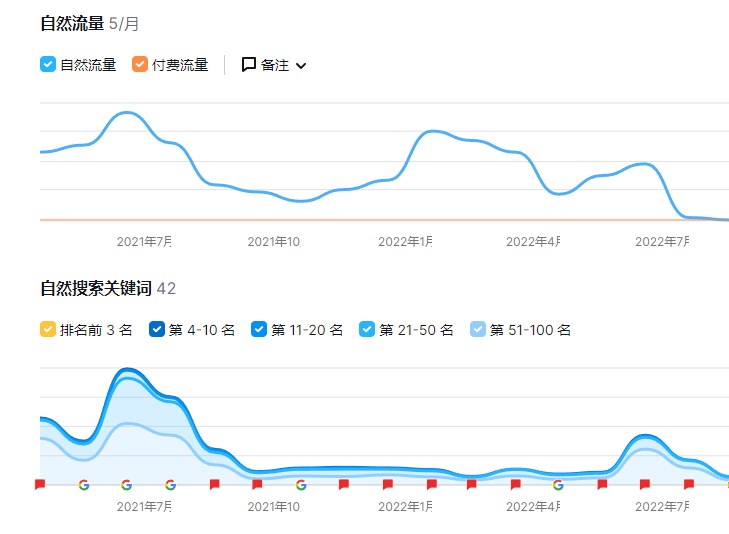
Ranking drops on established sites rarely have one cause: algorithm updates, lost authority, spammy backlinks, over-optimization, policy-violating articles. Any of them pushes rankings down, and inquiries follow. Editing pages on gut feel is usually wasted work.
The fix is a page-level audit. Build a table that lists each page's keyword, traffic trend, index status, ranking keyword count, internal and external links, and the action to take. Group pages by rising and falling traffic to find the reason.
| Page | Target keyword | Traffic trend | Index status | Ranking keywords | Action |
|---|---|---|---|---|---|
| Product page A | Core product term | Down 3 months straight | Indexed | Declining | Rewrite above-the-fold and spec table |
| Article page B | Industry informational term | Flat | Indexed | Stable | Add internal links, refresh data |
| Category page C | Location term + product term | Down | Not indexed | 0 | Merge into product page |
A real example from a bearing site: 262 pages in total (142 articles + 120 product pages). Working through the table page by page — rewriting pages with falling traffic or reworking their keywords — ranking keywords went from 1,545 to 3,027, and inquiries rose with them. The method isn't industry-specific; what it demands is the patience to look at every page.
Look at backlinks at the same time. Spammy links drag authority down; relevant, high-quality links lift rankings. The criteria are in the ultimate guide to English backlinks for foreign trade. One more thing: acquiring a new customer costs about 5x what it costs to keep an existing one. If your cost per inquiry is already high, squeeze the pages that already have traffic first.
FAQ
How many pages does a site need before inquiries become steady?
By the rule of thumb, 160 pages yields about 1 inquiry and 1,600 pages about 100; holding steady at 100 inquiries takes 3,200+ pages on average. A premium-content approach also works, but it demands far more original research and time. Multilingual pages count toward the total.
Will Google penalize AI-written product copy?
You won't be penalized for “using AI” — the problem is the content itself. AI-generated core copy tends to be vague, thin on detail and identical to competitors', so Google won't rank it. Use AI for polishing, grammar and logic, write the substance yourself, and your risk is lowest.
The site gets traffic but no inquiries — where's the problem?
Three usual suspects: the above-the-fold area doesn't say who you are and what you solve within 3 seconds; product pages have no spec table or MOQ, so buyers can't judge fit; and the form has too many fields. Name, email and requirement — three fields converts best.
Should I still build backlinks in 2026?
Yes. AI Overviews pull content from outside the top 10 — in Ahrefs' data, 31% of cited pages rank outside the top 100. But the page still needs a crawlable, indexable foundation. Backlinks remain one of the most direct ways to build authority; focus on relevance and quality, not volume.