

Is a Google Maps listing still worth doing for exporters in 2026?
Yes. But it isn't a traffic channel — it's proof of trust. When a customer picks up your card at a trade show, or spots your site in an email, the first thing they usually do is search your company name to see whether there's a real address on the map.
The 2026 search landscape makes this matter more. Google I/O 2026 put AI Mode at roughly 1 billion monthly users, with answers delivered above the results for most informational queries. Pew Research measured the effect: when an AI summary appears, about 8% of users click a traditional result; without one, about 15%. Fewer clicks on organic results — but more checking of whether you're a real company before anyone clicks at all.
Google is explicit about this: getting into AI Overviews and AI Mode needs no extra structured data and no special files. Good SEO is good GEO. That's exactly where a Business Profile earns its keep: company name, address, phone, website and real photos form a set of entity data Google can cross-check. Customers review that set before they decide to send an inquiry.
Why mainland Chinese companies can't register — three regions in one table
Open google.com/business, reach the address step, select China, and the page tells you straight: we must comply with international sanctions, so we can't support businesses in this region. Hong Kong, Macau and Taiwan are the exception. This isn't a technical problem, it's policy — different browser, different account, different proxy, same result.
| Where the entity is registered | Can you register a Google Business Profile? | Typical verification | What to do |
|---|---|---|---|
| Mainland China | No — selecting China triggers the sanctions notice | None | Register through an overseas entity, or embed a map on your own site instead |
| Hong Kong / Taiwan, China | Yes, with strict document checks | Video verification plus business licence, invoices and similar files | Have your local licence and proof of address ready in advance |
| US / Europe / Southeast Asia and other overseas markets | Yes | Usually postcard or phone verification | Overseas companies with a physical address register directly |
If you have no overseas entity, don't force this route. Embed a map and your NAP details (company name, address, phone) on the contact page of your site, add photos of the street entrance and the office area, and customers can still confirm you're a real factory or trading company. The difference: one shows up in Google Maps results, the other only on your own site.
Six steps from blank form to approved listing
- Using an overseas entity's business licence, open google.com/business, click "Manage now" and sign in with your Google account.
- Enter the business name and category. The name must match your licence, signage and website word for word — one extra character can get you rejected.
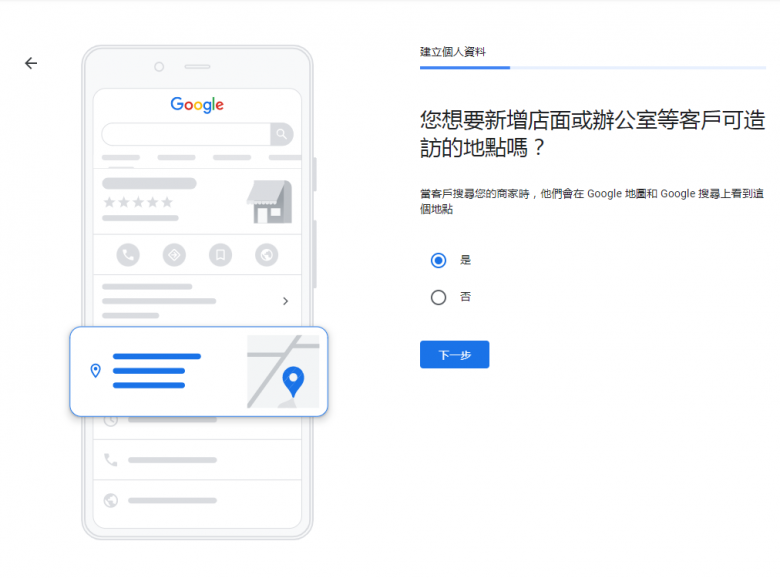
- When asked "Do you want to add a location customers can visit, like a store or office?", choose "Yes".
- Enter the address: postcode, country/region, street address. The country can't be China.
- Pick a verification method. Hong Kong and Taiwan businesses will most likely get video verification; overseas companies usually get postcard or phone verification.
- Once approved, immediately complete your opening hours, product categories, 10+ real photos and your website link — then post an update every week.
One warning: agencies are quoting 20,000 RMB to "handle your Google Maps listing", and exporters have already paid without getting a result. The profile itself is free. If you can fill it in yourself, do.
How to shoot the video verification and pass first time
Hong Kong and Taiwan businesses are often asked for video verification, and you don't have to be on site to shoot it. The point is to show the reviewer that you genuinely run this business at this address. One continuous take, no editing.
- Location footage: the street name and unit number on the building exterior, two or three neighbouring shop signs, the workspace on your floor.
- Equipment footage: branded vehicles, marketing materials printed with your company name, the tools and equipment you use to serve customers.
- Document footage: business registration certificate, invoices, utility bills, anything printed with the business name.
- People footage: the person on camera holding their ID and stating their role and what the business does.
Shot in that order, first-time approval rates are noticeably higher. If your documents aren't complete, don't rush the submission — a rejection puts you back in a slower queue.
Embedding a map slows your site down — how to protect LCP and INP
A Google Maps iframe is a heavy third-party resource. Drop it above the fold and mobile LCP easily passes 2.5 seconds. The 2026 Core Web Vitals thresholds haven't changed: LCP ≤ 2.5s, INP ≤ 200ms and CLS ≤ 0.1 for "good". Google's own data also shows that around 53% of mobile users leave when a page takes more than 3 seconds to load.
Three concrete moves: put a static screenshot in the map slot with a "View map" button and load the iframe only after the click; serve the hero image with an img tag plus fetchpriority="high", and hard-code width and height on every image to stop layout shift; defer GA4, chat widgets and pixel scripts until the first touchstart or scroll — INP drops a long way.
Then wait four weeks. Core Web Vitals uses a rolling 28-day window of real user data, so Search Console won't reflect the change straight away. A site that won't load, or an inquiry form that keeps spinning, undoes any map work — work through common reasons a foreign trade website gets no traffic or inquiries one by one.
Three more low-cost visibility spots beyond the map
One: reviews. Show your Google rating on your own site and customers see real feedback at a glance — far more convincing than claiming "10 years of experience" yourself. Here's how: embedding a Google star rating badge on a WordPress site.
Two: competitors. Read through competitors' About, product and certification pages and you'll see which trust materials you're missing. The method is here: analysing competitor websites to improve your own.
Three: backlinks. One real link from an English industry site, chamber of commerce or trade show news page beats bulk directory submissions by a mile. Path to follow: the ultimate guide to English backlinks for exporters. Once all of this is done, still confirm the site's foundations are sound first — if it needs rebuilding, look at foreign trade website design services.
FAQ
We have no overseas company or address — can we still be on Google Maps?
You can't register a Business Profile. What you can do is embed a map on your contact page with your company name, address and phone, plus real photos, so customers can verify you.
Does a Google Maps listing cost money?
The profile itself is free. The only spend is managed services — skip anyone quoting tens of thousands of RMB with a "guaranteed live" promise.
How soon after submitting will the company name appear on Google Maps?
Usually within a few days of approval. Review takes anywhere from a few days to two weeks, and video verification scheduling takes longer. Details that match your licence and website exactly usually go through faster.
Will a map listing bring more inquiries?
Not directly. It raises trust when a customer checks you out. Inquiry volume is still decided by keyword rankings, the spec sheets and MOQ on your product pages, and the number of form fields.