

In 2026, there is only one efficient path to find competitor backlinks: pull the competitor's referring domains with Ahrefs or Semrush, filter by relevance and site rank, then go back to each source page and look for a submission entry. Submit where you can; pitch guest posts where you can. Do not buy links, and do not send template emails in bulk—manually submitting to 50 relevant directories beats sending 500 bulk emails.
What is the most effective way to find competitor backlinks in 2026?
The path itself has not changed: review competitor backlinks, judge their value, and copy how they were earned. The criteria have changed. In the past, you only asked, “Does this site pass authority?” Now you need one more layer: “Will AI crawl this site, and will AI cite it?”
The threshold for AI citation is low: the page can be crawled, can be indexed, and is not blocked by nosnippet or max-snippet. So as long as a backlink sits on a page that is crawlable, indexable, and relevant to your industry, it delivers two kinds of value: ranking value and the chance to be summarized by AI as a source.
On the flip side, links on spam directories, comment sections, and irrelevant sites are basically worth zero in 2026—and can even hold you back.
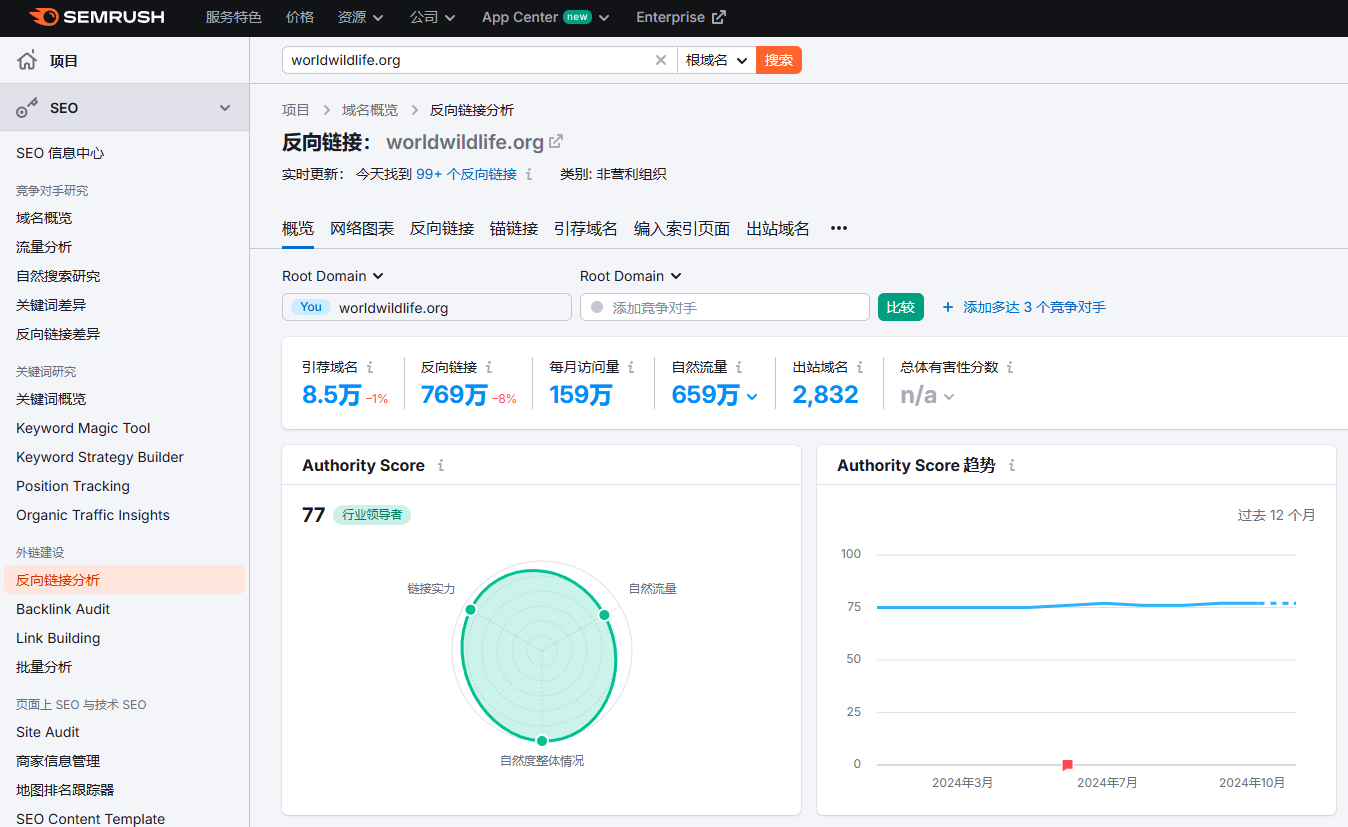
Which tool should you use to pull competitor backlinks? Ahrefs, Semrush, and free options
Put the competitor's domain into the tool and open “Backlink Analysis.” You will see total backlinks, number of referring domains, which page each link points to, and the anchor text. The operation is not hard; choosing a tool and controlling cost is.
| Tool | Data profile | Cost | Best for |
|---|---|---|---|
| Ahrefs | Backlink index updates quickly; referring domain and anchor text filters are granular; backlink analysis is usually more professional | Official site subscriptions are priced in USD; agency resale channels are much cheaper | Teams that build links long term and need fine-grained filtering |
| Semrush | Backlink overview and referring domain views are intuitive; you can see site by site how many links it gives competitors | The original article mentions agency channels at about CNY 18/month, compared with the official version at over USD 100/month | SOHO sellers and salespeople with limited budgets who want to validate the process first |
| Free backlink tools and public directories | Small data volume and slow updates; only suitable for spot-checking a single source site | 0 | People who only want to verify whether a source site is worth submitting to |
Bottom line: for systematic analysis, use Ahrefs first. If budget is tight, start with Semrush through an agency channel to get the process running, then upgrade once it proves effective. Tools are only the entry point; the real work comes later. For the overall playbook, read the ultimate guide to English backlinks for foreign trade so you do not focus on tools and miss the logic.
After you get the backlink list, how do you decide which ones are worth pursuing?
Three dimensions, in order of importance: relevance, source site rank, and link format.
Relevance decides everything. For a site selling industrial parts, links from industry directories, trade associations, and upstream or downstream supplier pages are far more valuable than general directories. Source site rank is the second filter. The example in the original article is practical: a directory ranked 1.93 million is worth submitting to; a site ranked 9.8 million can basically be skipped.
Link format matters. Links left in comments are easily judged as spam. Links in article body text and in guest author bios are the ones that stick. How to check: open the page where the competitor's backlink appears and see whether it is in “article content” or “user comments.”
- Industry directories, association member lists, trade show exhibitor lists — prioritize these; most have free submission forms
- Industry blogs where competitors have written guest posts — email to pitch a topic; success rates are higher than cold pitching
- Resource pages (pages like resources or links) — first check whether the site lists similar companies
- Forum signatures and blog comment links — skip; a waste of hours
- General directories ranked outside the top few million — skip unless they are free and highly relevant
From “seeing” to “getting”: 6 steps to turn competitor backlinks into your own
- Enter the competitor's domain in the tool and open backlink analysis.
- Switch to the “Referring Domains” view, pick out highly relevant sites, and save them in a table.
- Open each source page and confirm whether the link is in the body or in the comments.
- Go back to the site's homepage and find the submission entry. Common labels are list with us, submit your site, add listing, write for us, and become a contributor.
- Fill in company information, URL, and an English description of about 50 words. Use a company-domain email, not Gmail.
- Record the submission date and status in the table. If there is no reply after two weeks, follow up once. Link building works like cold email: follow-up matters more than the first send.
This table should include at least 7 columns: source site domain, rank, relevance, link format, submission entry URL, submission date, and current status. After about 100 rows, you will find that only a few dozen sites are actually submittable—and they appear repeatedly in multiple competitors' backlinks. These are must-pass nodes in the industry and deserve priority. To dig deeper, combine this with how to analyze competitor websites and match their traffic pages with their backlink pages.
After AI Overviews launched in 2026, are backlinks still worth building?
Yes, but expectations need to change. Ahrefs research from March 2026 shows that only 37.9% of URLs cited by AI Overviews also appear in the top 10 organic results for that query, down from about 76% in July 2025. Another 31% of cited pages rank outside the top 100. Pew Research testing shows that when an AI summary appears, about 8% of users click traditional results, versus about 15% when there is no summary.
These numbers show two things: the shape of the results page has changed, and clicks are being intercepted. But the ranking logic has not changed; AI simply takes pages that already rank and summarizes them. Backlinks still affect rankings. They just deliver fewer click returns and instead create a chance to be cited.
Supporting actions need to keep up: pages must be crawlable and indexable; do not enable nosnippet. Put conclusions early in the body so they are easy to excerpt as a one-line citation. Keep the inquiry path short; on the first screen, explain in 3 seconds who you are and what you solve. Backlinks send you up; the page decides whether you keep the visitor. This is also the real reason many sites rank but get no inquiries. Check yourself against why your export website has no traffic or inquiries.
FAQ
Can you directly copy a competitor's backlinks?
You cannot copy the links themselves, but you can copy the channels. If a competitor got a link from a source site through a guest post, email them to pitch a topic. If they got it by submitting to a directory, go fill out the form. Channels are reusable; links are not.
How many directories should you submit to per day?
By hand, 5 to 10 relevant sites a day is a sustainable pace. Over a month, that gives you more than 100 valid submission records. Bulk-submitting to hundreds of directories with mass-mailing software looks busy in the short term, but the risk of being judged as spam is high. Not worth it.
Are free backlink tools enough?
They are enough for initial filtering, but not for systematic analysis. Free tools have small data sets and slow updates, so they easily miss high-quality links competitors recently earned. If budget allows, use Ahrefs. If budget is tight, Semrush through an agency channel works perfectly well.
What should you watch out for with guest post backlinks?
Three points: the site is relevant to your industry, the article itself has substance, and the link is in the body rather than piled up at the end. You can use tips for writing articles and product descriptions with ChatGPT to improve efficiency, but check terminology and data manually. Editors can spot a template-style article at a glance.