

Why FAQ Pages Are Worth More in 2026 Than Ever
Google I/O in May 2026 reported that AI Mode has about 1 billion monthly users. AI Overviews now answer a large share of informational queries right at the top of the results. Pew Research measured the effect: when an AI summary appears, about 8% of users click a traditional result. Without a summary, about 15% do.
Your buyer's question is already answered on the results page. Whether they still click through depends on whether you wrote the sentence that got quoted. A FAQ page has exactly the right shape: one specific question, one direct answer. If a buyer asks "what's your MOQ" and your page says "MOQ 200 pcs, mixed colours can share a carton, samples in 7 days", that sentence has a shot at the AI Overview.
An Ahrefs study from March 2026 is worth a look if you run an export business: of the URLs cited in AI Overviews, only 37.9% also ranked in the top 10 organic results for that query, and another 31% ranked outside the top 100. The pool of sources is widening. Fixing how you write is a better first move than chasing rank.
What a Good FAQ Entry Needs
One rule of thumb from the original piece: a good FAQ page covers about 80% of the questions your site visitors arrive with. At the level of a single entry, the test is simpler — can a buyer read this one block, go nowhere else, and make a decision?
| Dimension | Weak version | Strong version | The difference |
|---|---|---|---|
| Answer length | One line: "contact us for details" | 2–4 sentences: conclusion first, then conditions | AI only quotes answers that stand on their own |
| Specificity | "competitive price, reliable quality" | "FOB Shenzhen, USD 3.2/pc from 500 pcs" | Buyers compare numbers side by side |
| Question wording | "product advantages" | "can your goods pass EU CE certification" | Only the buyer's own words match search terms |
| Page uniqueness | Same Q&A copied onto 5 pages | Appears on the 1 most relevant page | Stops your pages competing with each other |
One point gets ignored a lot: don't repeat the same Q&A across pages. Duplication makes it hard for search engines to decide which URL to index, and it shows buyers two versions of the same answer on different pages. That is how trust disappears before the enquiry.
When you mention specs, lead times, certifications or payment terms, give the full number. Nobody quotes a page that says "short lead time". A page that says "25 days for standard items, 35 days in peak season" gets screenshotted and forwarded to the purchasing manager.
Where to Get FAQ Questions: 4 Sources You Can Copy
You don't need to invent questions. Real questions from a foreign trade site have left a trail. Just go dig them out.
- Sales reps' emails and WhatsApp logs: copy the exact sentences buyers used over the last 3 months. Don't rewrite them into formal English — if they wrote "can you send 2 samples first", copy that.
- The "requirements" field on your enquiry form: what buyers write in their own words is the most honest long-tail keyword list you will get. Fewer fields, cleaner text — name, email and requirements is the three-field setup that converts best.
- Competitors' FAQ pages: list the Q&As from three rivals line by line and see what they answered and what they skipped. For the method, see using competitor site analysis to improve your own site.
- "Related questions" in Google results and query data in Search Console: sort queries containing a question mark by how often they appear. The top 20 are basically your FAQ table of contents.
Once the list is tidy, turn each answer into short sentences that can be quoted as-is. If you get stuck, a tool can help you draft, but your own numbers have to come from you — see tips and caveats for writing articles and product descriptions with ChatGPT.
Where the FAQ Goes: Homepage, Product Page or a Standalone Page
The original conclusion — put the FAQ on the homepage where possible — still holds in 2026, but it needs layers. Homepage: 5–8 of the highest-frequency closing questions. Product pages: 3–5 questions tied tightly to that product. A standalone FAQ page holds the full set, covering shipping, payment, after-sales and certification.
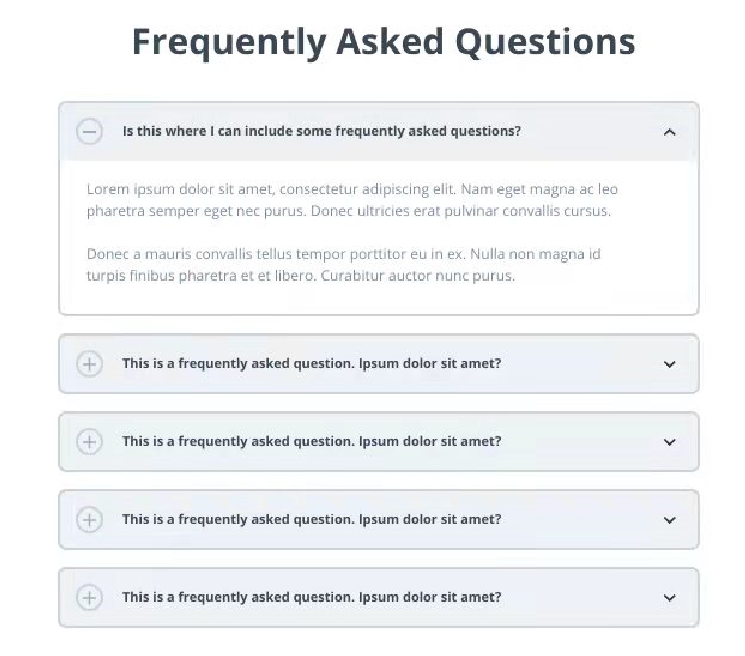
Save the homepage slot for questions that decide the order: MOQ, samples, lead time, payment terms, shipping method. Company history and the founder's story belong on the standalone FAQ page, not above the fold. Whether the backend allows visual editing and whether the first item opens by default are standard details in foreign trade website building services.
If a site can't even fill 10 Q&As, skip the standalone FAQ page for now. Fill in the spec table and MOQ on your product pages first — that drives enquiries more directly. And if the site has no traffic at all, read why your independent foreign trade site has no traffic or enquiries; the problem usually isn't the FAQ.
Making It Crawlable: 3 Technical Checks
Google has been clear: getting into AI Overviews and AI Mode needs no extra structured data, special files or Markdown. "Good SEO is good GEO." Here are the three things actually worth checking.
- The page can be crawled and indexed: robots.txt doesn't block it, the page has no noindex, and the Q&A block isn't limited by nosnippet, max-snippet or data-nosnippet. If any of these is wrong, even great writing never reaches the AI answer.
- Q&A in real text, not just images and popups: text inside a JS layer or baked into an image never reaches the crawler. Accordion FAQs are fine, but the answer must exist in the HTML source.
- Speed must not drag you down: the Core Web Vitals "good" thresholds are LCP ≤ 2.5s, INP ≤ 200ms and CLS ≤ 0.1. About 53% of mobile users leave if a page takes more than 3 seconds to load. Serve the hero image with an img tag and add fetchpriority="high", hard-code width and height on every image, and defer third-party chat scripts until the user's first interaction.
Don't check Search Console straight after the fix. Core Web Vitals runs on a rolling 28-day window of real user data, so give it 4 weeks before the numbers reflect the change.
Common Questions
How many Q&As does a FAQ page need
5–8 on the homepage, 3–5 on each product page, and 15–30 as the cap for a standalone FAQ page. Start with the real questions your sales team got in the last 3 months. Fewer is better than padding — filler Q&As dilute the important ones.
Do I need FAQPage structured data
You can add it, but it isn't a prerequisite for AI Overviews. Google has stated plainly that no extra structured data is required. Writing complete answers that contain numbers does more than adding markup.
If AI copies my answer, won't buyers stop visiting my site
It will be quoted, and that is the opportunity. Pew measured about 8% click-through when an AI summary is present versus about 15% without, and the top result for queries with an AI Overview loses roughly 34.5% of its clicks. Leave something in the answer that only a click reveals — a full spec table, a packing list, a certification list — so the summary becomes an entry point.
Do accordion FAQs hurt SEO
No, as long as the answers are in the HTML source. What to avoid is stuffing whole Q&As into images or pure JS layers. For the default way to build the Q&A module, see the B2B foreign trade website plan page.