

Bottom line: ChatGPT can write product descriptions and articles, but you can't publish them as-is. In 2026, Google's AI Overviews summarize pages that already rank, and content without first-hand experience won't get cited. The workflow: have it build the outline and first draft, run the draft through a plagiarism checker, rewrite the overlaps down to 0%, then add your own spec data, MOQ and real cases.
What actually goes wrong when ChatGPT writes product descriptions
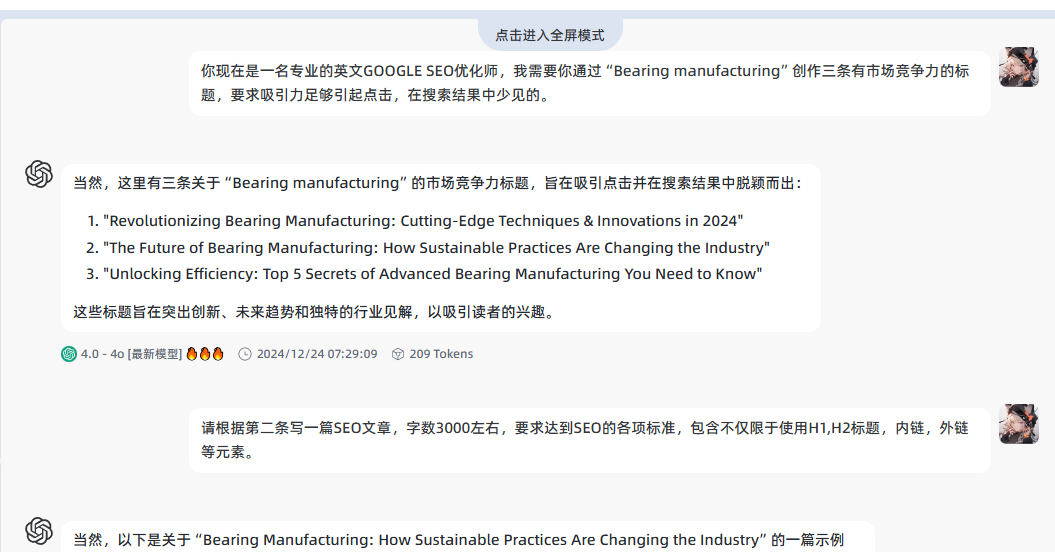
We tested it on needle bearings and asked ChatGPT to generate a product description straight off. On the surface it looked complete: structure, applications, FAQs, all there. Run it through a plagiarism checker and 9.1% of the sentences matched copy already online.
The reason is simple. It works by recombining what is already on the web: many sources, shallow rewriting. The result "doesn't look copied, but reads familiar."
Google looks at EAT: experience, expertise, trustworthiness. A description with no operating conditions, no measured data and no MOQ hits none of the three. In 2026 this matters more: in Ahrefs research from March 2026, only 37.9% of URLs cited in AI Overviews also appeared in the top 10 organic results for that query, versus about 76% in July 2025. Citations are spreading out, but the base is still the same: crawlable, indexable, rankable.
A workflow that actually works: AI draft + tool check + human rewrite
If you are not a copywriter, follow these 4 steps. Each one has a clear deliverable.
- Give full context before asking AI to write. Don't just drop a product name. Put the spec table, material, precision grade, typical customer industries, MOQ and lead time into the prompt.
- Check for plagiarism right after generating. Run it through a third-party tool and highlight the sentences that match existing text.
- Rewrite the duplicated parts line by line. The goal isn't some percentage, it's 0% similarity. Swap in your own parameters and scenarios as you rewrite.
- Add something AI can't write. A real photo, a set of measured data, a case of how you resolved a customer complaint. That is the real differentiator on the page.
If you can write, flip the order: write the draft yourself and use ChatGPT only for grammar and sentence polish, then still review it manually.
Seeing how competitors write also helps you spot industry boilerplate. Analyzing competitor websites to improve your own lays out a comparison method: pull 3–5 competitor product pages, list the expressions that keep repeating, and you'll know what to avoid.
What a professional product description looks like: needle bearings as an example
The common flaw in AI product descriptions is that everything is covered and nothing is deep. The table below breaks the job down by section and marks what to hand to the tool and what you must do yourself.
| Section | What ChatGPT can do | What you must add |
|---|---|---|
| Product overview | Write a generic definition and structure description | Model range, precision grade |
| Specifications | List the common parameter fields | Real values, tolerances, test conditions |
| Applications | List industry names | What equipment the customer runs, how many hours it runs |
| Selection advice | Give generic decision logic | Mistakes you have made, wrong selections that cause high rework rates |
| MOQ and lead time | Can't write these | All supplied by you |
| FAQ | Can draft 5–8 questions | Real data and cases in the answers |
Follow this split and AI handles structure and language while you handle facts. A description with 2–3 numbers that only you can provide won't be treated as generic copy.
Article writing: use ChatGPT for three early-stage tasks only
Ask it for a full article and you get correct structure with hollow content. It pays off far more at the front end.
- Build the outline. Enter needle bearing and it returns a framework such as introduction, history, applications, types, design factors, mounting and running. Then you cut and adjust it against the questions customers actually search.
- Draft titles. Ask for 20 at a time and use them for inspiration only. Don't adopt them directly.
- List keywords. Ask for 100 related terms at once to quickly map a category's vocabulary. Useful for picking terms, writing titles and setting structure.
The first draft still has to come from a person. Replace each outline section with your own factory data and cases, and the article has a chance of being cited.
One more trap: asking AI to rewrite competitor copy or generate outreach email templates tends to produce highly similar output. In our tests, template similarity reached 90%. Check everything before publishing. Same for link-building copy; see the ultimate guide to English link building for exporters.
AI search changed in 2026, and content requirements changed with it
Pew Research measured it: when an AI summary appears above the results, users click traditional results about 8% of the time; without one, about 15%. Ahrefs data shows the top-ranking result's CTR drops about 34.5% on queries with AI Overviews.
That doesn't mean rankings are dead. Google says it plainly: getting into AI Overviews and AI Mode requires no extra structured data, special files or Markdown. Good SEO is good GEO. AI simply summarizes pages that already rank.
To raise your odds of being cited, a page must meet three conditions: crawlable, indexable, and not blocked by nosnippet / max-snippet / data-nosnippet. On the content side, use short sentences that state conclusions directly and use tables for specs, so AI can pull quotable sentences out more easily. For this structured approach, see the build logic in AI integrated marketing websites.
Technical checks before content goes live
Great content on a slow page is wasted. Over 3 seconds of mobile load time and about 53% of users leave.
- LCP ≤ 2.5s: load the hero image with an img tag and fetchpriority="high", not a CSS background-image. Otherwise the browser has to parse CSS before it even discovers the image.
- INP ≤ 200ms: delay third-party scripts such as GA4, Meta Pixel, live chat and popups until the user's first interaction.
- CLS ≤ 0.1: set width and height on every image.
- Image naming and alt: use the English product name, not IMG_2031.
- Inquiry form: name, email and requirement. Three fields convert best, so fewer is better.
Core Web Vitals uses a 28-day rolling window of real user data, so after a fix you wait 4 weeks to see it in Search Console. Don't judge it the next day.
If the site has content but no inquiries, check the structure first. Why your export website gets no traffic or inquiries lists the usual causes.
FAQ
Can I publish a ChatGPT product description as-is?
No. Directly generated descriptions overlap with existing sentences. In our test, 9.1% of sentences matched. Check first, rewrite to 0% similarity, then add your own parameters and cases.
Will Google penalize AI-written content?
Google penalizes low-value content, not AI itself. The test is whether the page shows experience, expertise and trust. AI drafting plus human-added facts carries very low risk.
Do I need extra optimization for AI search?
No extra structured data or special files. Keep pages crawlable and indexable, avoid nosnippet-type directives, and get content quality and load speed right. That is enough.
What if I can't write copy?
Use the flow: AI builds the framework, you fill in the data, a tool checks duplication. Or use a paid AI writing platform for the draft and verify the facts manually. The key is that a human reviews it before publishing.