

In 2026 there is only one hard standard for a manufacturing website: within three seconds of landing, a visitor must know what you make, who you make it for, and where to click next. Miss that and no amount of design work will hold the inquiry. Google data shows that when a mobile page takes more than 3 seconds to load, about 53% of users leave.
The 2026 standard for manufacturing sites: say three things in the first three seconds
The three things are: what the product is, who the customer is, and what action to take. Industrial buyers are not shopping for clothes — most arrive with a specific model or material in mind. Add one extra step and they are gone.
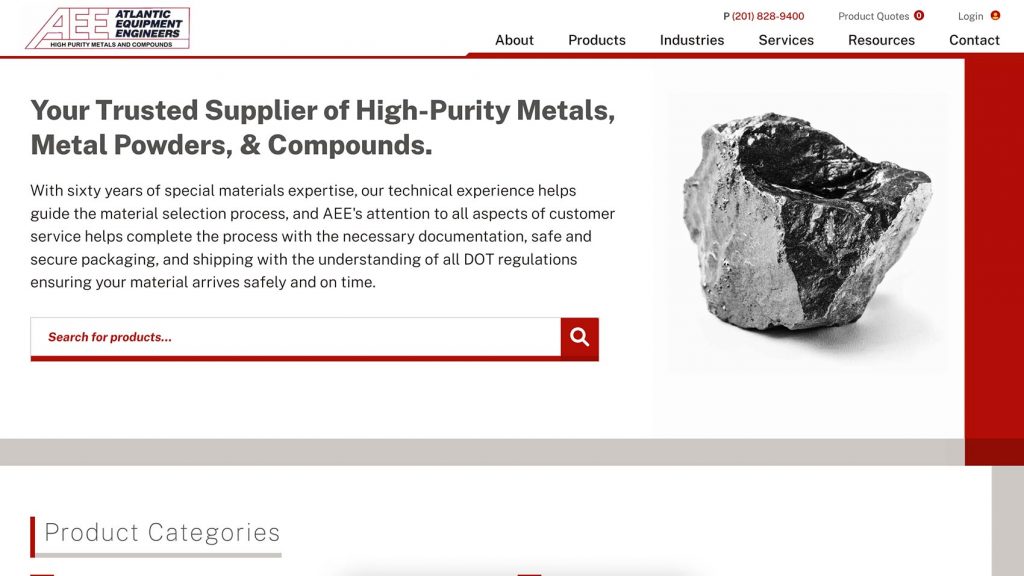
Atlantic Equipment Engineers (MicronMetals.com) puts the search box in the middle of the homepage; type “titanium” and suggestions appear automatically. Most of its visitors already know what they need, so search is the shortest path. The product detail page then works like a checkout page built around “Request a Quote” — one straight line to the end.
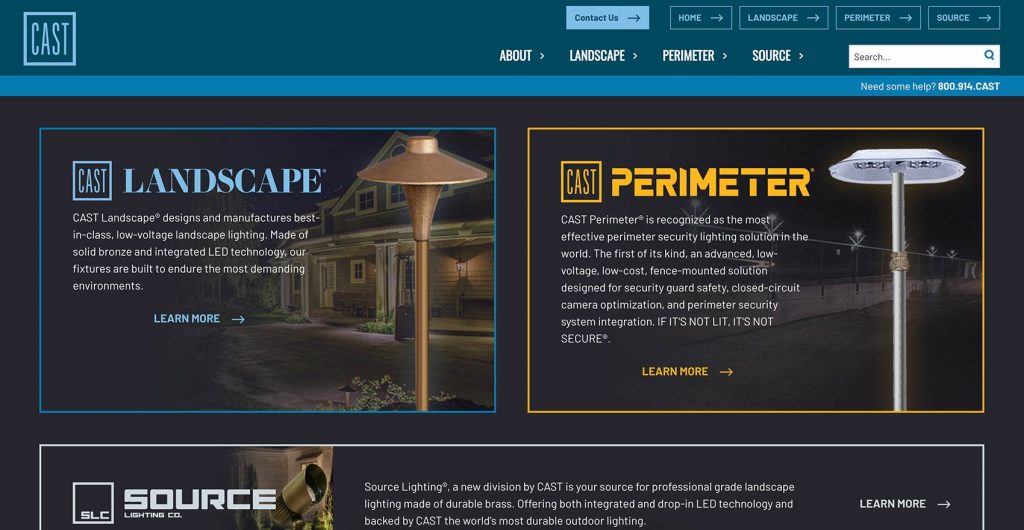
CAST Lighting takes another route: three product lines laid out flat on the homepage, one click into a category, and a switcher in the top right corner. Neither site relies on flashy tricks. Both just cut the number of clicks.
There is a crude way to judge a homepage: send a screenshot of the first screen to a friend who has never heard of your company and ask what products they see within three seconds. If they cannot answer, redo it.
8 industrial website examples: which tactics still work in 2026

In this batch of manufacturing and industrial website examples, 8 carry complete information. What they share is not visual style but the way they break product selection into clickable steps.
| Website | Industry | Tactics still worth copying in 2026 |
|---|---|---|
| Atlantic Equipment Engineers | Metal powders and compounds | Large search box on the homepage with live suggestions; quoting built into product pages |
| CAST Lighting | Landscape and security lighting | Three product lines in separate zones; filters by fixture type and style |
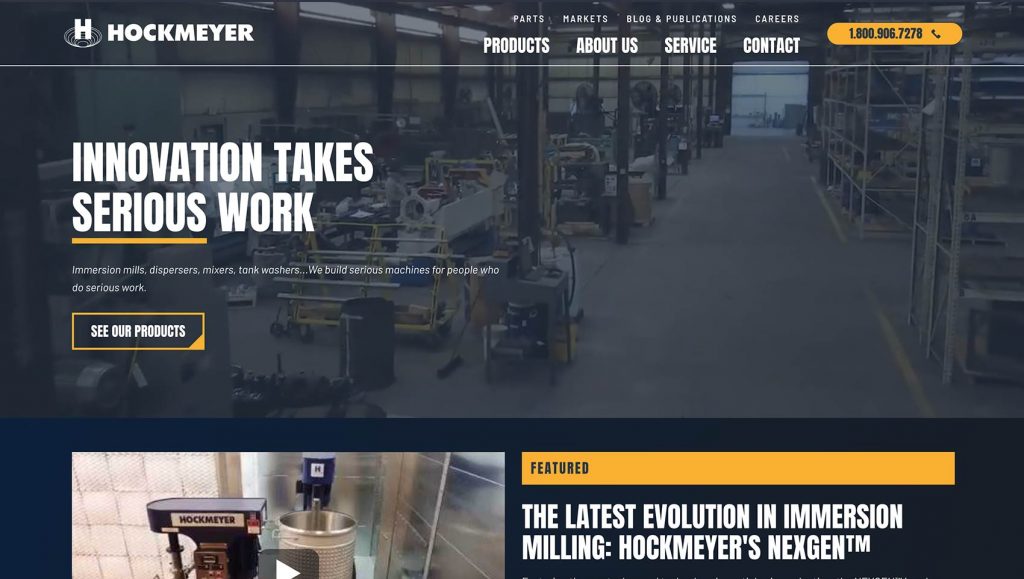
| Hockmeyer | Wet grinding equipment | Product dropdown limited to 7 categories; downloadable spec sheets on the page |
| Applechem | Cosmetic ingredients | Factory video builds trust; competitor comparison charts on product pages |
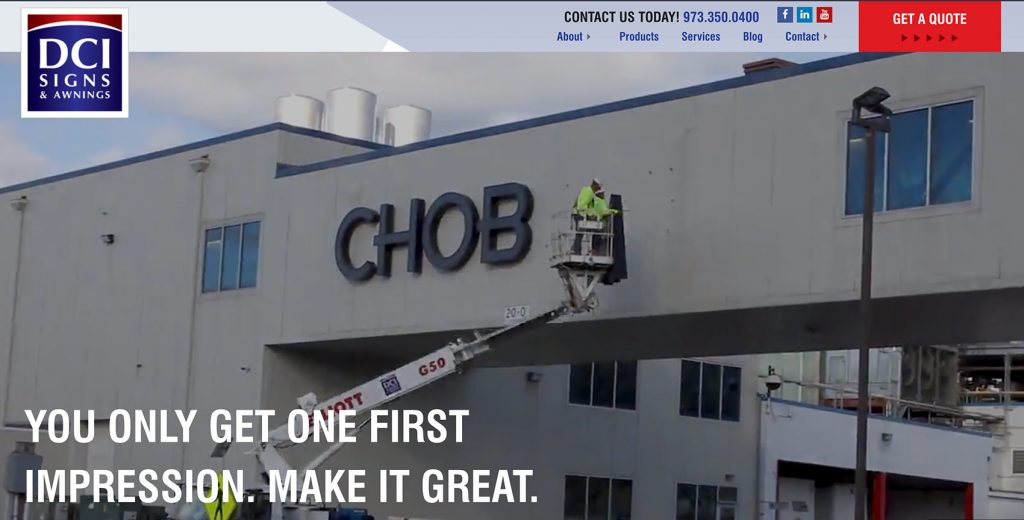
| DCI Signs & Awnings | Custom outdoor signage | Spec Builder, a nine-step configurator that ends in a quote |
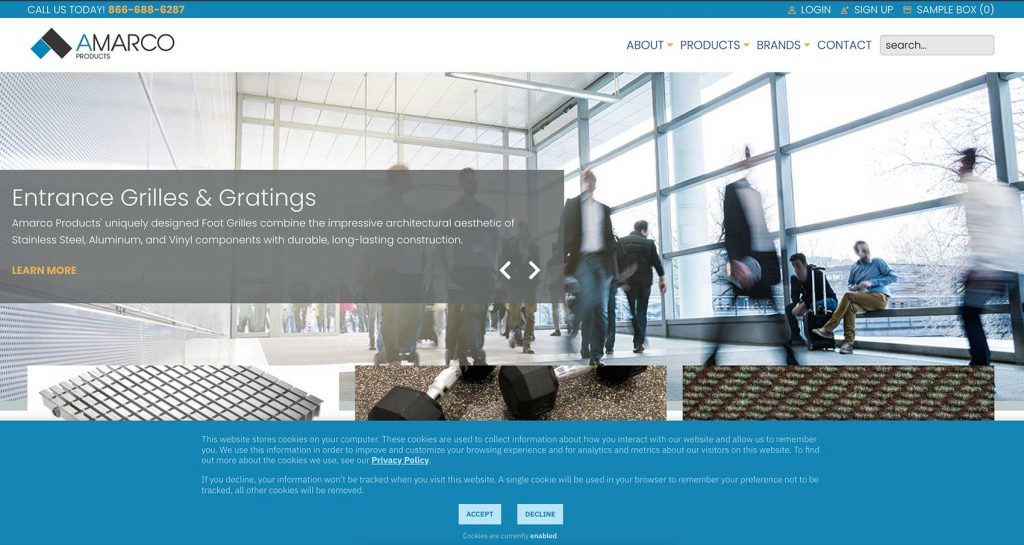
| AMARCO Products | Mats and rubber flooring | Non-ecommerce site still lets buyers add samples to cart, capturing demand |
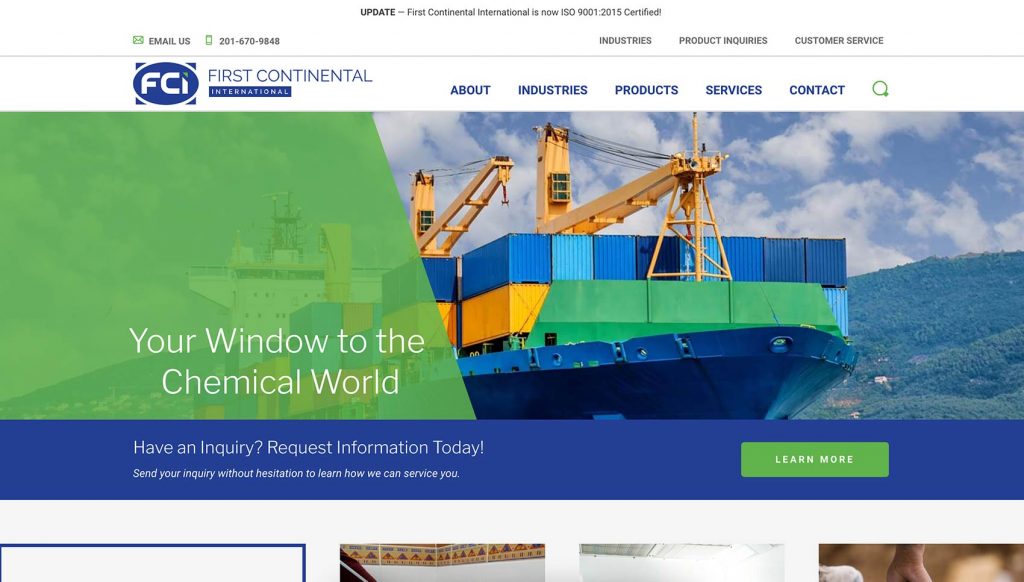
| First Continental International | Chemical distribution | Product pages list CAS and EINECS numbers plus synonyms; regulated items go through an inquiry form |
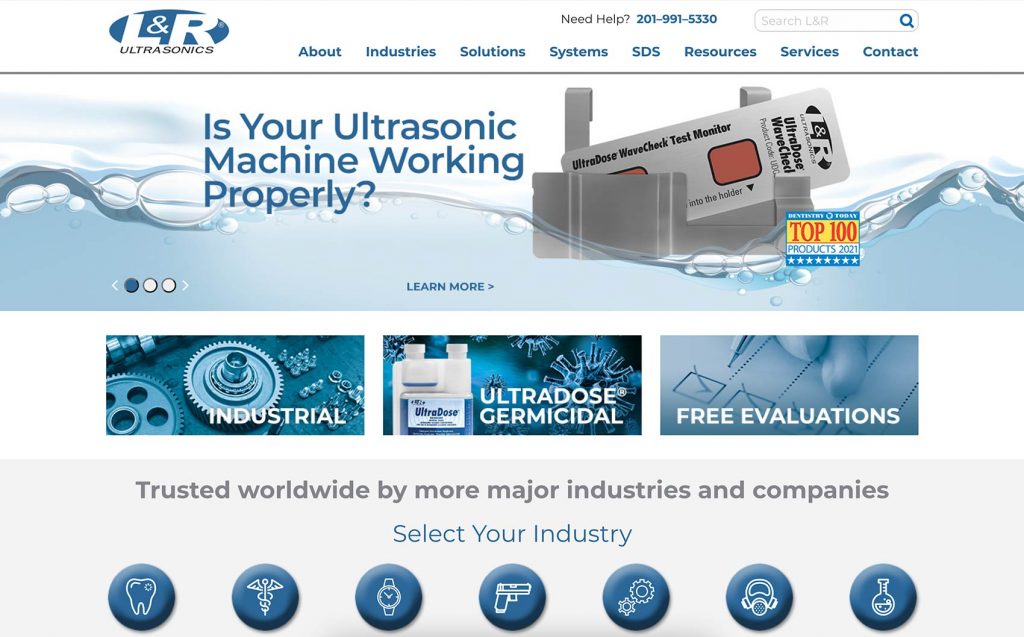
| L&R Ultrasonics | Ultrasonic equipment | Products grouped by application instead of stacked model numbers |
Do not just look at the color schemes on these sites. Count the clicks it takes to get a spec sheet, count the fields on the inquiry form, and check whether the product page states lead time.
To benchmark against competitors systematically, run this process: analyze competitor websites, and focus on whether product pages carry the three essentials — spec table, MOQ and lead time.
5 modules every manufacturing homepage needs
Keep the module count under 5. Packing a dozen product images into the first screen is the same as having no flagship product.
- One-line positioning: what you make and which customers you serve, written in the headline area.
- Flagship category entry points: 3 to 6. Any more and users cannot choose.
- Trust elements: certifications, years in business, client logos, real workshop video.
- Application industry entry points: give “Industries” its own tab like FCI does, so customers can find you by their own field.
- Inquiry entry point: a form with only name, email and requirement.
For homepage structure, follow a proven B2B foreign trade website framework instead of sketching from scratch. When you redesign, export the inquiry form submissions from the old site — they are more persuasive than any design mockup.
How to lay out product pages so browsing turns into inquiries
The product page is where deals happen. Industrial visitors look for only four things here: can you make it, what does it cost, what is the minimum order, and how fast can you deliver.
- Spec table: material, dimensions, tolerance and packaging, laid out as a table, not a paragraph.
- MOQ and lead time: state the minimum order quantity and standard production days.
- Downloadable PDF spec sheet: Hockmeyer's approach, so engineers can take it away and read offline.
- Application photos: CAST shoots products in real working environments, which persuades better than white-background shots.
- Comparison table: Applechem uses one table to show how its ingredients differ from substitutes.
- Quote button: one at the top, one at the bottom, none in between.
Fewer form fields is better. Name, email and requirement converts highest. Every extra dropdown — say, company size — loses another batch of people.
If a site gets traffic but no inquiries, the problem is usually the product pages, not the homepage. Work through this: why your foreign trade website has no traffic or inquiries.
AI search in 2026: will industrial sites be cited in AI Overviews?
An Ahrefs study from March 2026 is worth noting: of the URLs cited in AI Overviews, only 37.9% also appear in the top 10 organic results for that query, down from about 76% in July 2025; another 31% rank outside the top 100.
Pew Research measured it directly: when an AI summary appears, about 8% of users click through to traditional results; without a summary, about 15%. For queries with an AI Overview, the top result's click-through rate drops by about 34.5%.
Google states it plainly: getting into AI Overviews and AI Mode requires no extra structured data, special files or Markdown. Good SEO is good GEO. There are only three criteria — the page is crawlable, indexable, and not restricted by nosnippet or max-snippet.
What you can do is simple: put the conclusion in the first sentence of every section, use tables for specs, and phrase common questions as question headings. That is the kind of sentence AI can quote directly, and every section of this article does it.
Technical floor: Core Web Vitals standards for 2026
| Metric | Good threshold | Common drags on manufacturing sites |
|---|---|---|
| LCP | ≤ 2.5s | Hero factory photo set as a CSS background-image; no fetchpriority |
| INP | ≤ 200ms | GA4, Meta Pixel, live chat and popups all loading at once |
| CLS | ≤ 0.1 | Images without fixed width and height; font shifting |
| TTFB (secondary) | 30–80ms | No edge cache on the origin, so overseas visitors fetch across the ocean |
Three traps are most common. A hero image set as a CSS background-image forces the browser to parse CSS before it even finds the image, which drags LCP down — use an img tag with fetchpriority="high" instead. Skip fixed width and height and CLS will fail. Load third-party scripts together and INP is basically unrecoverable; the safe pattern is to load them after the first user interaction (touchstart, scroll, keydown). Cloudflare APO costs about USD 5 per month and caches HTML at edge nodes.
Ranking page builders by INP cost, worst to best: Elementor, Divi, WPBakery, Beaver Builder, Bricks, GenerateBlocks, Kadence Blocks, native Gutenberg. A real migration case: a 30-page site moved from Elementor to Bricks, INP dropped from 290ms to 110ms, LCP from 3.4s to 1.9s, and the migration took about 16 hours.
INP officially replaced FID in March 2024. Core Web Vitals uses a rolling 28-day window of real user data, so changes take 4 weeks to appear in Search Console. Before you start, check the budget tiers — website package and price comparison covers them.
FAQ
Does a manufacturing website need an online store?
Not necessarily. AMARCO is not an ecommerce site, but it lets customers add samples to a cart; FCI's products are regulated, so it uses inquiry forms only. The test: if it ships as a standard item, take orders online; if it needs selection and quoting, use an inquiry form.
How many images should a product page have?
One main image, 2 to 3 detail shots, 2 application photos, and 1 spec or certificate image — keep it under 8. Give every image fixed width and height so the images do not blow up CLS.
How soon will inquiries change after a redesign?
Technical metrics show up in Search Console in about 4 weeks. Inquiry volume also depends on product page content and ad spend, so track the trend by quarter, not by week.
Should I build a separate set of pages for AI search?
No. Google states clearly that there are no extra technical requirements for AI Overviews. Putting conclusions first, specs in tables and FAQs as questions works far better than building a second set of pages.